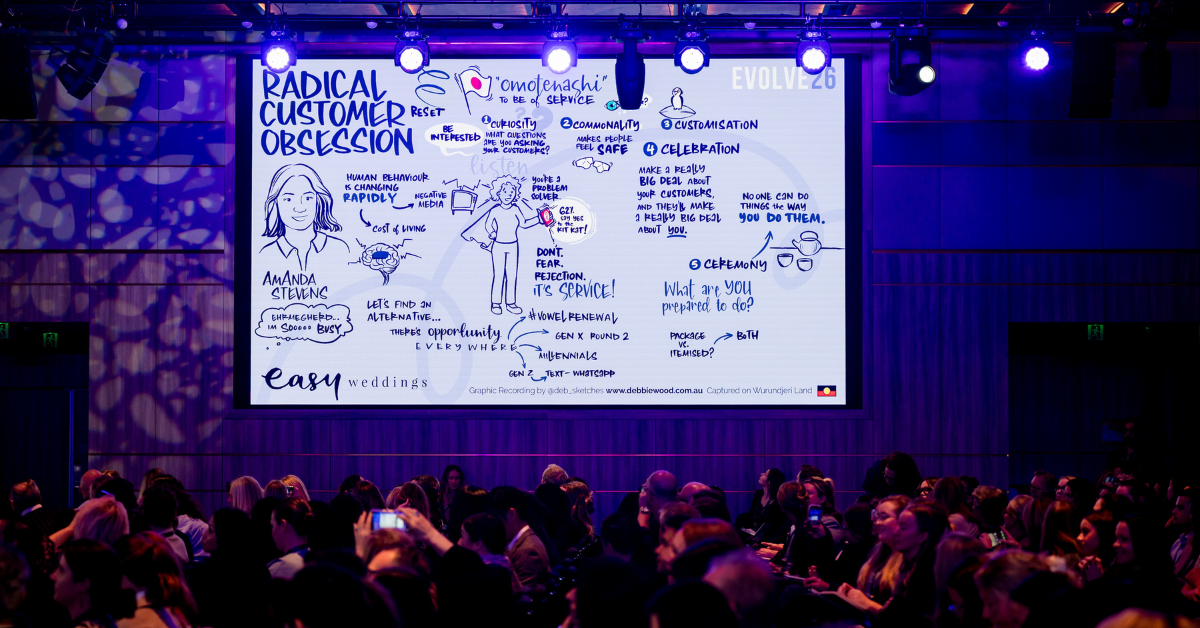
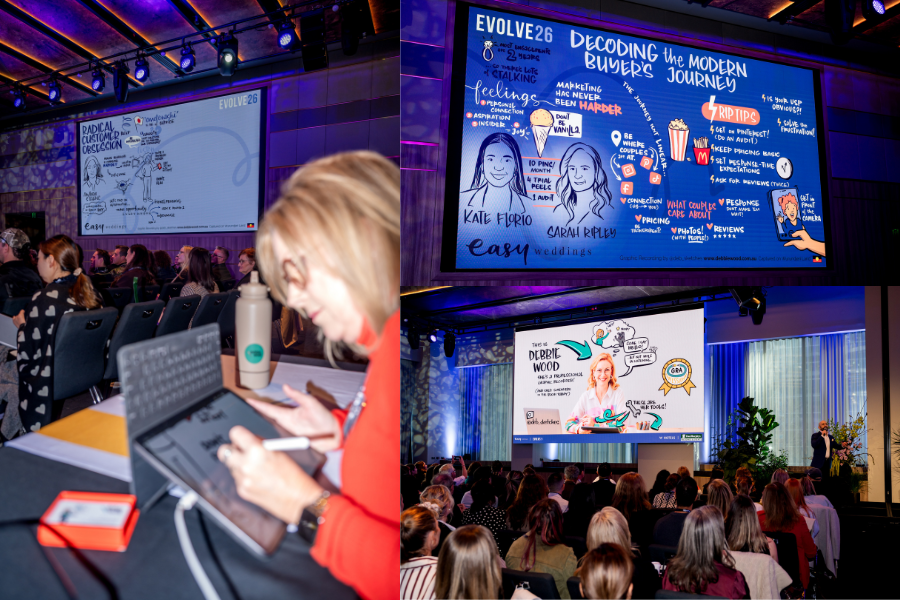
Imagine watching your own keynote, panel or big idea come to life right in front of you. Not just on another slide, but as a visual story taking shape word by word, in real time. That’s what graphic recorder Debbie Wood brings to corporate events.
As speakers talk, conversations develop, and ideas percolate, Debbie listens, distils and illustrates the key concepts live, transforming words into an evolving visual that gives attendees another way to connect with what’s being said.
We caught up with Debbie to find out what happens behind the canvas, how live illustration changes the conference experience, and why it pays to literally draw the bigger picture.
Where did the drawing start? Were you the kid who was always sketching, or did it come to you later?
I was the creative kid, for sure. And busy! If I wasn’t doodling in my workbooks I was chatting in class. I loved drawing from a young age, and was OBSESSED with lettering and colour. I had that awesome 80’s book called “The Lettering Book” and every assignment I ever handed in had the most spectacular headings.
In high school, there was a term where one of the sport options was calligraphy, and instead of getting out on the netball or volleyball court, I would trot off to the art room with my fancy fountain pens and work on my script font! Gosh what a dork.
You were a graphic designer before this. What made you put down the mouse and start drawing live in front of a room full of strangers?
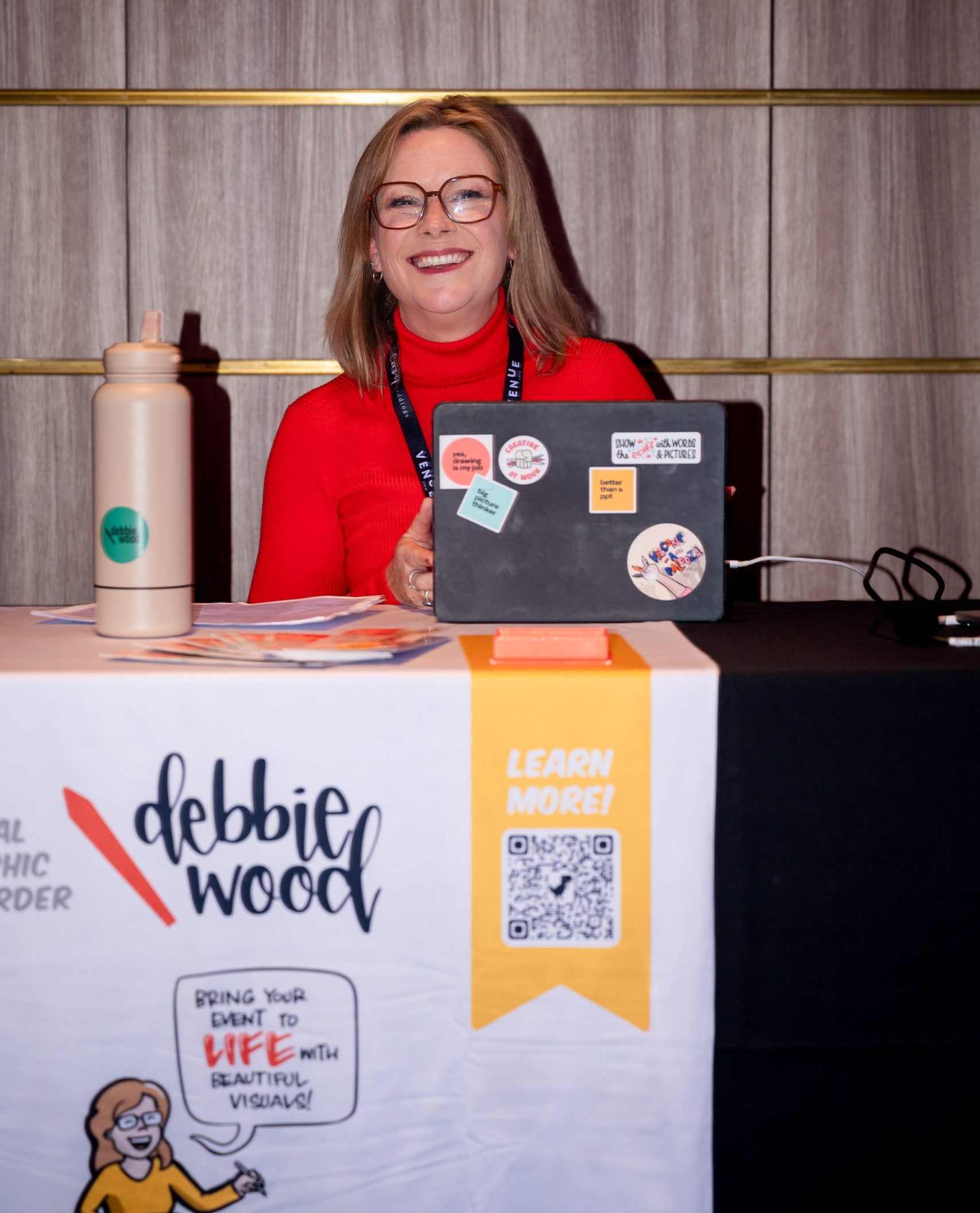
It really was a happy accident. I found out about this work through a friend of a friend and curiosity had me wanting to try it! I’ve kept at it because I love the rush I get from performing under pressure – and more importantly, at every job I see the difference it makes for my audience.
Where did the concept of Graphic Recording come from?
The practice of graphic recording started on whiteboards in the States in the 70s, and grew into a solid part of many large consultancy firms during the 90s & early 2000s. MG Taylor methodologies were part of EY, Cap Gemini & PWC’s creative consultancy offering – solving big problems in different ways.
Graphic recorders found their way out of this purely corporate consultancy world and into the conference world after that – and it certainly serves a room full of learners or participants in different ways depending on the context. During workshops, my words and pictures keep everyone connected and on the same page as they work through problems and ideas. During conferences, my words and pictures keep everyone in the room and more engaged in what they’re listening to.
Where were you born and raised and where are you living now?
I grew up on the Gold Coast, spent my 20s in Brisbane (apart from a 1-year hiatus – a working holiday in the UK at 24), then fell in love with Melbourne after coming back from Europe.
I moved to Melbourne because of an obsession with swing dancing (Melbourne has the biggest scene outside the US). Not long after that I found myself a husband (who didn’t dance), and we’ve enjoyed 20 years in the Inner North raising our two awesome boys.
My folks are on the coast and I’m at the point in time where I feel like it’s important to spend more time with them. My kids are older and pretty self-sufficient too. It’s not expansion or anything that wild, it’s homecoming – so I split my time between both now, and honestly, dual citizenship suits me.
What was that first live job like — do you remember how you felt and the experience?
I can’t remember my first time… but I do remember my first big conference – a room of about 600 people. Walking in to set up and seeing all those chairs. When I work with markers on paper I generally have my back to the room. I get myself into a flow state using the ‘peripheral vision’ technique. It kind of slows my breathing, widens my range of focus and awareness and seems to create a perfect state of being for doing what I do!
Talk me through the hour before you start. What’s going on in your head?
I always get to the venue an hour before folks start to arrive so I can get set up and make best friends with the AV team. At this point coffee is important! I also like to reacquaint myself with the session plan or agenda and all of the timings because that helps me know what’s coming.
When a speaker’s mid-sentence, how do you decide in a split second what’s worth drawing and what isn’t?
There’s something in the way a speaker says something that tells me what’s important and what’s less so. This is hard to describe! I’m listening for the energy in their voice, the pictures they paint with their words, the reaction from the room. Also, what has come before, and how things connect.
You’re working in front of hundreds of people with no undo button. What happens when you get something wrong?
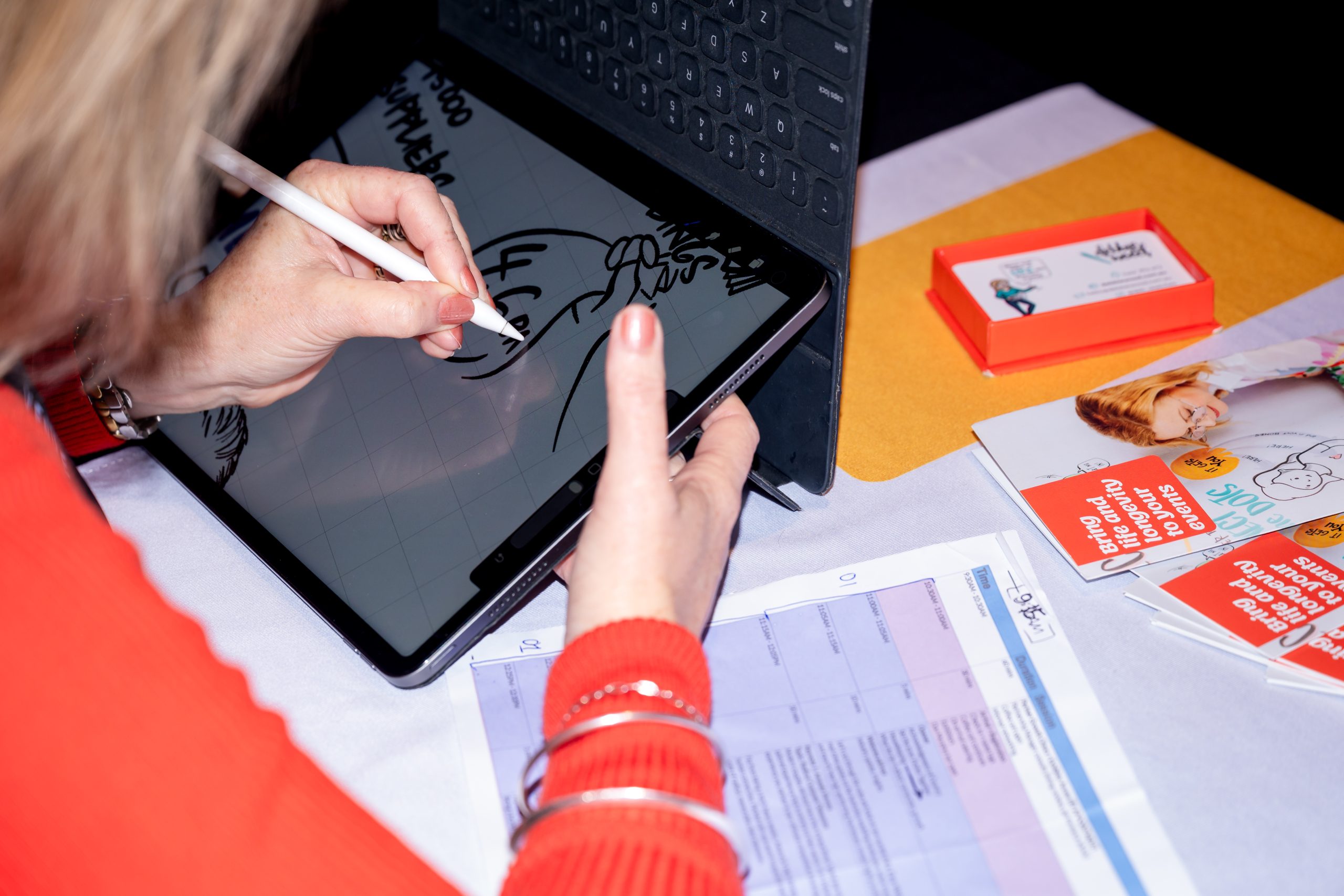
Oh, I do have an undo button! When I’m working with markers at the wall, I
carry white labels with me to cover anything that’s not right. When I’m illustrating on my iPad, I move things around in the moment, and certainly hit the undo function from time to time!
I think it’s important that the audience sees those things too – that they see the decisions I’m making. They see that it’s human made, and that I’m paying attention! In this world of increasing AI output – a human has listened, with her own filter for ideas and things, and she’s made sense of what she’s heard in this very cool way.
You’ve captured everything from post-quantum cryptography to Elders yarning on Country. What’s been the hardest thing you’ve ever had to make visual?
I think the technical conferences can be the most challenging – when you’re
in a room full of civil engineers or computer scientists or medical researchers. You’ve always got the best of them, the brightest minds, on stage sharing their knowledge – and I need to make sense of it so that I can draw what I hear!
I do a lot of work in the for-purpose arena, where conversations are harder, but I find visualizing those discussions easier. That work is really important to me.
Has anyone ever reacted to one of your canvases in a way you didn’t expect?
The reaction of appreciation and amazement used to surprise me at first, but these days I love it. It solidifies for me why I do this work and how important it is for folks.
A reaction I often get is people coming up and pointing out one of the smaller ideas or jokes that have made their way into the work. I call them Easter Eggs. I love making sure there’s something in the canvas that connects everyone to the moment.
Oh gosh! I just can’t wait til next year! It was such a well-run event. The vibe in the room all day was high – thanks to an awesome emcee and some really interesting and informative speakers. That venue at W Melbourne is just world class. It was my second time working in that room and of course I just LOVE the size of those big digital screens.
What events/jobs do you have coming up?
From now until the end of the year, I’ve got a real variety of jobs coming up. From teeny tiny workshops with just 6-8 participants, to a couple of bigger symposiums. The subject matter list is interesting! Education, people and culture, community safety, child safeguarding, domestic violence and alcohol and other drugs!
You can see from those subjects that it’s not decoration. While my work is beautiful, it’s not wallpaper – it’s a working tool. I’m always saying that things can be both sparkly and useful! My work captures decisions, builds buy-in in the room, and gives people something to refer back to long after the slides are forgotten.
In the moment it’s keeping everyone connected to the ideas that are being shared – and it’s super helpful for folks who are visual learners (65% of us), or where English is a second language.
Are there any projects or new ideas you have that you want to try?
I hope this doesn’t sound morbid, but I think capturing a funeral would be awesome. I’d love to see what I could do capturing a eulogy, then hearing stories from loved ones at a wake. I think it would also make a really great keepsake for a family.
I’m also wanting to get graphic recording happening at EVERY CONFERENCE happening across the country – but certainly on the Gold Coast! The Coast is such a great destination for Australian conferences, and everything is always quite elevated and razzle dazzle up there. Graphic recording would fit that vibe SO well – and it always makes the experience for attendees so much richer.
The applause might stop and the lanyards eventually come off, but the best ideas from an event shouldn’t disappear with them. Debbie’s finished illustrations give audiences and planners something tangible to revisit, share and repurpose, extending the value of those conversations well beyond the room. It’s exactly how Debbie’s illustrations, in her own words, “bring life and longevity to your stories.”
Because a great idea deserves to last longer than the slide deck it arrived on.
Enquire today to discover how Debbie Wood can bring your event conversations to life and create visual stories that keep your biggest ideas going long after the event ends.
Feeling overwhelmed by the venue hunt? Our friendly Venue Specialists are here to help — get in touch with them today.